
yes 
Three Limitations Worth Knowing Before You Switch
 srcoll arrow
Compostable vs. Recyclable Cups: Which One Is Actually Right for Your Shop?
0 Comments
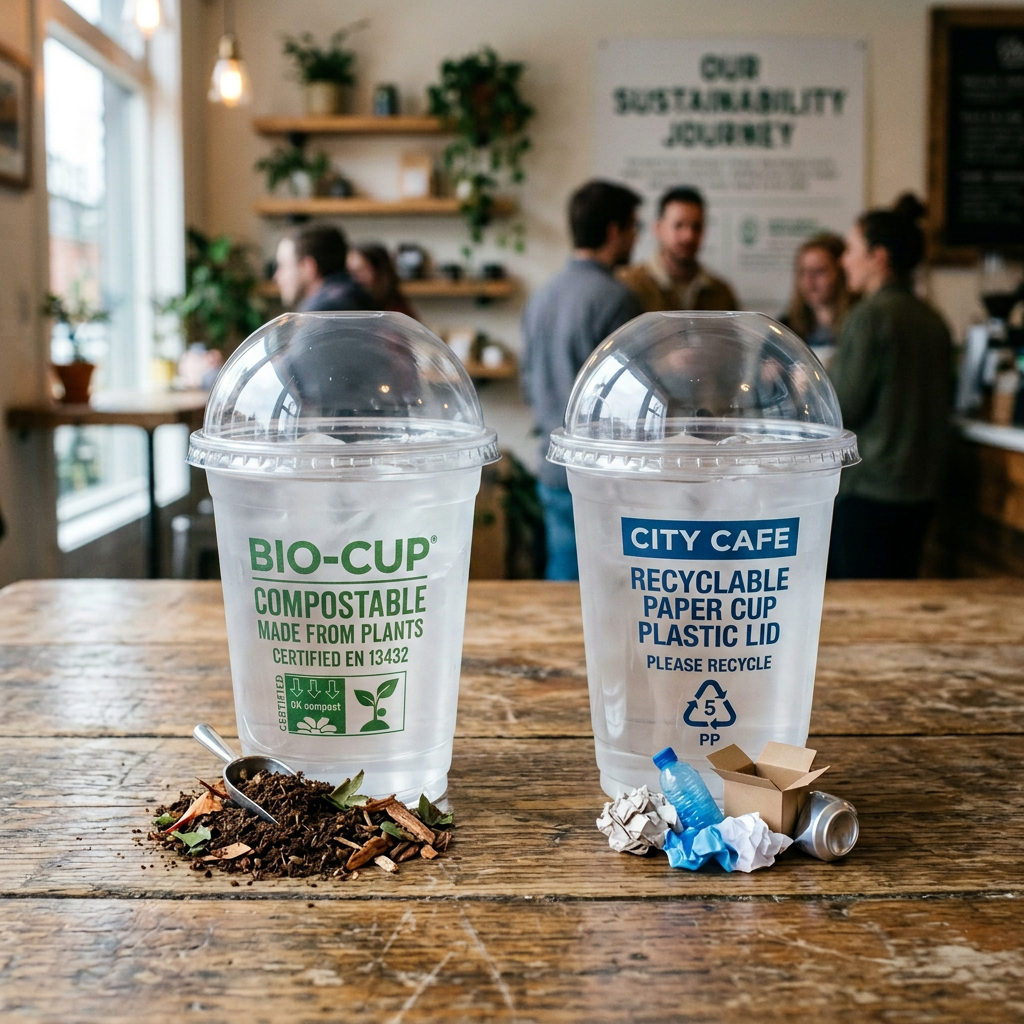
“Compostable” sounds like the obvious upgrade. It’s often priced at a premium, it’s marketed as the more responsible choice, and plenty of shop owners assume paying more for it is simply the cost of doing the right thing.
But compostable packaging isn’t automatically the better fit for every business — it has specific conditions it was designed for, and outside of those conditions it can end up performing no better than a standard recyclable cup, while costing you more. Before you commit to one material over the other, it’s worth understanding exactly what each one requires to actually work as intended.
What “Compostable” Actually Means
Almost every compostable cup on the market today is made from PLA (polylactic acid) — a plant-based bioplastic, usually derived from corn starch, that can biodegrade under the right conditions. That last part matters more than most marketing suggests: PLA products certified by the Biodegradable Products Institute (BPI) meet ASTM D6400 or D6868 standards specifically because they’re designed to break down in a managed compost facility — not in a landfill, and not necessarily in a backyard compost bin. Without that specific environment, PLA behaves much more like conventional plastic than like something that will simply disappear.
Three Limitations Worth Knowing Before You Switch
- Not every area has the facility to process it. Industrial composting access has grown, but it’s still far from universal. According to 2025 research from the Sustainable Packaging Coalition, only about 35.9% of the U.S. population has access to any composting program at all — and just 18.1% have access to a program that specifically accepts compostable packaging, as opposed to food scraps only. If your city or county isn’t in that group, your “compostable” cups are headed to the same landfill as everything else.
- Takeout and delivery orders rarely make it into a compost stream. A compostable cup only composts if it’s sorted into a composting bin. For dine-in service where you control the waste stream, that’s achievable. But for takeout and delivery — where the cup leaves with the customer and ends up in whatever bin is closest to them — the odds it’s correctly sorted drop sharply. If a large share of your orders go out the door, the environmental benefit you’re paying for may never actually be realized.
- It only works if your whole operation commits to it. Mixing compostable cups with regular plastic lids, straws, or napkins in the same waste stream creates a sorting problem, and contamination is exactly what breaks recycling and composting systems alike — as waste management resources on recycling contamination point out, mixed-material waste often gets rejected outright rather than processed. Going compostable only pays off if it’s a full commitment across your disposables, not a single product swap.
The Storage Issue Nobody Mentions
There’s a practical limitation that has nothing to do with waste infrastructure: PLA has a shelf life. Left in storage, PLA cups typically hold up well for at least six months, and can last meaningfully longer in a cool, dry environment — lower temperature and lower humidity both slow the material’s breakdown. But that clock is always running. Industry storage guidance generally recommends keeping PLA products in a cool, dry space out of direct sunlight, since heat and light exposure accelerate degradation — the cups gradually become more brittle and noticeably less clear over time. If you bulk-order compostable cups and they sit in a hot stockroom for a year, you may be serving drinks in cups that are already past their best condition.
So Is Recyclable Any Better?
Recyclable cups (typically PET or PP plastic) sidestep the composting-infrastructure problem, but they come with their own asterisk: actual recycling rates. Nationally, plastics recycling in the U.S. has been falling, not rising — a recent Beyond Plastics analysis found the overall plastics recycling rate has slipped below 6%, down from 8.7% in 2018. And food-service items are especially vulnerable to being rejected even when a customer does the right thing and puts them in the recycling bin: leftover food and drink residue is one of the most common reasons recyclable items get pulled out and sent to a landfill instead, since contaminated materials lose their resale value to recyclers. Recyclability, like compostability, depends heavily on your local infrastructure and how clean the item is when it’s tossed.
How Cupstomize Helps Either Way
Whichever material fits your business, Cupstomize carries both: our Custom Compostable Cold Cup is made from PLA for shops with the right composting access and order mix, and our Custom Recyclable Plastic Cup and Custom Recyclable Round Bottom Plastic Cup lines cover everyone else.
Not sure which option fits your shop? Reach out for a free consultation, and we’ll help you figure out what actually works for your waste stream and order volume — not just what sounds the most sustainable on a spec sheet.
© Copyright 2026 Cupstomize. All right reserved